We started with another delicious breakfast buffet (sans the preserved egg), and then headed on the bus to TianAnMen Square. This square is 110 acres, and can fit one million people standing shoulder to shoulder. It is made of cement squares that can fit about 2 people each (see my picture above of our feet). On October 1st every year 1 million people fill the square holding strategically different color flowers, which viewed from above spell our Chinese characters such as "peace" and "Long Live the Chinese Communist Party.'' There were SO MANY people everywhere- countless tour groups swarming around guides holding red flags. The line that was quickly moving to view Chairman Mao's body was fed by an endless stream of people. Where were they all coming from?? Everywhere we go it is crowded with tours and people rushing around.
Most of the structures in Tiananmen Square are from this century. The exception is the Tianenmen Tower, which was built in 1417 during the Ming Dynasty (1368-1644). This tower is at the north of the square, opposite the Mao Zedong Memorial Hall on the south. The east is the National Museum of China across from the Great Hall of the People in the west. In the middle of this plaza (claimed to be the largest city public sqare in the world) is the Monument to the People's Heroes, of martyrs who devoted their lives to the Chinese people.

We continued walking north until we reached "The Forbidden City," aka Gu Gong in Mandarin. The name is because this imperial palace (used during Ming and Qing dynasties) was only for royal family members. The emperors lived here and no workers or common people could enter. This holds another superlative title, being the world's "largest palace complex."


The Forbidden City is divided into two parts: Outer Court (in the south) was where the emperor exercised his supreme power over the nation and held many ceremonies, and the Inner Court (north) where he lived with his royal family and held his daily activities. There used to be 9999 1/2 rooms in the Forbidden Palace, because the emperor believed he was the son of heaven, and heaven had 10,000 rooms, and he wouldn't have more rooms than heaven. 14 Ming emperors and 10 Qing emperors reigned here until 1924 when the last emperor of China was driven from the Inner Court. They say it took over 1 million workers 14 years to build it- from 1406 to 1420. There is a great movie called "Curse of the Golden Flower" that has many scenes filmed here. I think it is by the same director of "Crouching Tiger, Hidden Dragon."


Walking through the foggy Forbidden City, the red and gold buildings were never-

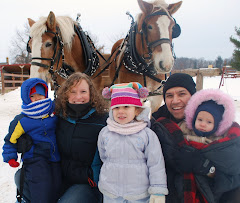
ending. There were a lot of decorative gold-leaf dragons and lions, and so many tourists (99% were Chinese) we got separated from the group frequently. Vivi was a doll, and apparently the Chinese think so too. Women come up and either take her from our arms (literally) and take a picture with her, or if she is walking they will grab her hand and then hug her for a picture. We are thinking that maybe they have seen American adults, but kids are more of a rarity? You wouldn't believe how many times she had her picture taken today by this paparazzi (as well as the other little girl in our group, Stephanie, who is 6). Most of the time Vivi tolerates it and smiles for their cameras, and I wonder why she isn't a little bit freaked out?
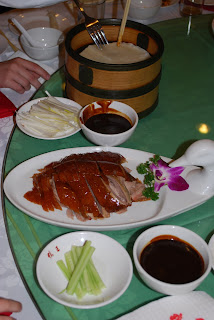
After we toured the Forbidden City, we took the bus to lunch to have the famous Peking Duck- the 300 year old recipe of roasted duck, served with thin pancakes (like tortillas), soy bean paste, and sliced cucumbers and spring onions. Vivi ate a huge bowl of the cucumbers and another of rice- she kept saying "no me gustan los patitos" (I don't like duckies).

After lunch, we walked across the street to the CHI Beijing Office and watched a touching powerpoint about our trip to China, how it will be to receive our kids, what other humanitarian work the CHI foundation has been doing. Everyone was getting very excited about meeting our kids (some are meeting them tomorrow, others on Monday).
 Soon we headed tot he bus again, to make our way to the Great Wall. The Great Wall, (aka Wan-Li Qang-Qeng) is over 2000 years old. The Chinese name means 10,000 Li Long Wall, where 10,000 Li= 5000 km. It was built (actually part of it was built but just to connect several old walls) during the Qin Dynasty (221 BC - 206 BC) under the emperor Qin Shi Huangdi. Although that sounds old, the truth is there were older walls in the north of China from 700 BC (2500 years ago!) that this emperor connected and expanded. Armies lived on these walls to defend against those darn Huns (the invading nomads who in the 400's BC fought under Attila the Hun).
It is constructed of masonry, rocks and packed-earth. Its thickness ranged from about 4.5 to 9 meters (15 to 30 feet) and was up to 7.5 meters (25 feet) tall. During the Ming Dynasty (1368-1644), the Great Wall was enlarged to 6,400 kilometers (4,000 miles) and renovated over a 200 year period, with watch-towers and cannons added. The towers could observe the enemy, and below they would store grain and military equipment. Every 400 meters or so is a watchtower, from which they would send smoke signals to warn of attacks. Our visit was to the Juyongguan/ Juyon Pass, which was a very important pass due to its strategic location leading to Inner Mongolia and northwen Beijing.
It was a very cold and foggy day, and the steps were covered with ice and snow. Nonetheless, we hiked up very far with Vivi. This was only possible with the help of our friend Scott Miller (see his blog on the left: "Drew Us to Him"), who held one of her hands and Tonio the other and just kind-of half walked and half pulled Vivi up mountain. Seriously, we would not have been able to climb up otherwise- it was so slippery and the stairs were very steep. Some were up to Vivi's waist, others were no higher than 2 inches. The ice was so slippery!!! But really I think going down was more dangerous. You could see the faint shadows of the mountains surrounding us, but the fog was so thick it blurred our vision. The sight from the top was breathless (because of its beauty and because we were out of breath from the hike). I still can't believe Vivi made it up!!?? AND back down again in one piece!? I'm pretty sure the hundreds of people around us were saying "Why are those crazy Americans walking up the Great Wall with their 3 year old!!??" Whatever, it was worth it!!!! (thank you Scott!!!) 


 Today we met at 6am to go to the airport, for our flight to Urumqi. The 4 hour flight from Beijing to Urumqi seemed really short after crossing the ocean.. The majestic snow-capped Tian Shan mountains out the window were breathtaking!
 After landing we met our guide, Wendy, and took the bus to our hotel. Vivi, Lily (the 4 year old), Stephanie (the 6 year old) and Brian are becoming good little buddies. In the plane Vivi and Lily watched videos together, colored, played with playdough- and then they all sat in the back of the bus together squealing and giggling at something the way to the hotel.


 Here is the view from our hotel room (which doesn't face the square):
 Towards the end of the day, Vivi was really getting tired (poor little girl!!). Every day around 5 she just can't keep her eyes open anymore. She usually falls asleep between 5-6pm and there is NOTHING we can do to wake her up and get her to eat. So the problem is she misses dinner and then wakes up from 1am-3am to eat, go to the bathroom, etc. You would think we could just try to feed her dinner earlier, but ti never works out with the touring, or today signing paperwork, etc. She is SO tired, poor baby, and she hasn't been eating very well because she won't try any of the food (except the rice!). She has been surviving on fruit, some veggies, and rice. Today we bought some yogurt, fruit, and chocolate milk at a supermarket across the plaza from the hotel, but she was too zonked out to eat. Hopefully tomorrow we can load her up! She is such a trooper though, even though she is hungry and exhausted. What a sweetie-pie!!